Mumbai—the city that never sleeps, India’s financial powerhouse, Bollywood’s beating heart—is also, surprisingly, one of the nation’s most spiritually rich destinations. Hidden between gleaming skyscrapers and bustling streets lie centuries-old temples, tranquil mosques, historic churches, and meditation centers that offer peaceful sanctuaries from the metropolitan madness.
The spiritual places in Mumbai tell a fascinating story of religious diversity and cultural harmony. In this cosmopolitan metropolis, you’ll find devotees from every faith coexisting peacefully—Hindus, Muslims, Christians, Buddhists, Jains, Parsis, and Jews all maintaining their sacred traditions while contributing to the city’s unique spiritual tapestry.
Whether you’re a devotee seeking divine blessings, a spiritual seeker searching for inner peace, a history enthusiast fascinated by religious architecture, or simply a curious traveler wanting to understand Mumbai’s soul beyond its commercial facade, exploring the spiritual places in Mumbai offers profound and enriching experiences.
This comprehensive guide covers over 25 sacred sites across Mumbai—from the most famous pilgrimage destinations that attract millions annually to hidden gems known primarily to locals. We’ll explore Hindu temples, Islamic dargahs, Christian churches, Buddhist meditation centers, Jain temples, and more, providing complete information about their history, significance, visiting hours, and how to reach them.
Why Mumbai is a Unique Spiritual Destination
Before diving into specific sites, it’s worth understanding what makes the spiritual places in Mumbai special:
Religious Pluralism: Few cities in the world display such genuine religious diversity. Mumbai’s spiritual landscape includes major Hindu temples, significant Islamic shrines, historic Christian churches, Buddhist meditation centers, beautiful Jain temples, Parsi fire temples, and even rare Jewish synagogues—all within a few square kilometers.
Ancient and Modern Coexistence: Many spiritual places in Mumbai are centuries old, yet they function vibrantly in one of Asia’s most modern cities. This juxtaposition creates a unique atmosphere where ancient rituals unfold against backdrops of contemporary urban life.
Accessibility: Unlike pilgrimage sites in remote mountains or isolated villages, Mumbai’s spiritual places are easily accessible via the city’s extensive public transportation network. You can visit multiple sacred sites in a single day.
Cultural Festivals: The city celebrates every major religious festival with equal enthusiasm—Ganesh Chaturthi, Eid, Christmas, Buddha Purnima, Mahavir Jayanti, and Parsi New Year—making Mumbai a year-round destination for witnessing living spiritual traditions.
Architectural Diversity: The spiritual places in Mumbai showcase remarkable architectural variety—ancient cave temples, colonial-era Gothic churches, Indo-Islamic dargahs, contemporary Buddhist pagodas, and traditional Hindu mandirs—creating a visual feast for architecture enthusiasts.
Hindu Temples: Heart of Mumbai’s Spiritual Heritage
Hinduism is the majority religion in Mumbai, and the city boasts numerous temples ranging from ancient shrines to modern architectural marvels. These spiritual places in Mumbai are not just religious sites but also cultural landmarks that have shaped the city’s identity.
1. Siddhivinayak Temple: Mumbai’s Most Beloved Deity

Location: S K Bole Marg, Prabhadevi, Mumbai 400028
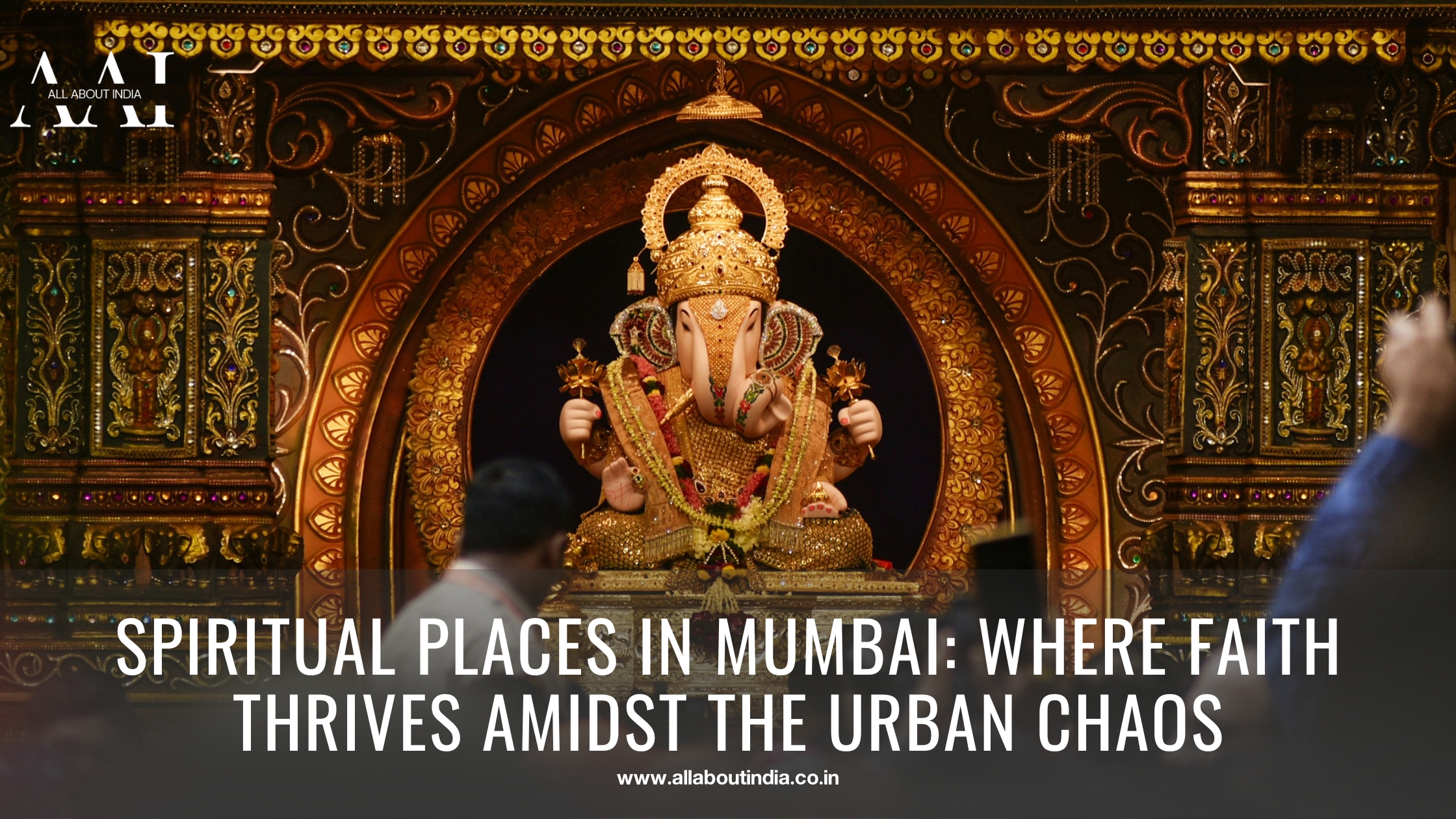
The Siddhivinayak Temple is arguably the most famous among all spiritual places in Mumbai. Dedicated to Lord Ganesha—the elephant-headed deity of wisdom, prosperity, and remover of obstacles—this temple attracts over 200,000 devotees daily, with numbers swelling to millions during festivals.
History and Significance: Built in 1801 by Devbhai Patil and his wife Laxmibai Patil, the Siddhivinayak Temple has become synonymous with Mumbai itself. The story goes that the childless couple built this temple after years of prayer, hoping to help other devotees fulfill their wishes. Today, it’s believed that wishes whispered into Lord Ganesha’s ear are granted, making this one of the most powerful spiritual places in Mumbai for devotees seeking divine intervention.
The temple is one of the eight Ashtavinayak temples scattered across Maharashtra, each believed to be swayambhu (self-originated). The wooden idol of Siddhivinayak shows the deity with his trunk turned to the right—a rare feature in Ganesha iconography, considered especially auspicious.
What Makes It Special: The temple’s spectacular dome is plated with gold donated by a devotee in 1995, making it shine brilliantly against Mumbai’s skyline. The inner sanctum houses the revered wooden idol adorned with precious gems and gold ornaments, flanked by his consorts Riddhi (prosperity) and Siddhi (spiritual power).
Visiting Details:
- Timings: 5:30 AM to 10:00 PM (Monday-Saturday), 3:15 AM to 10:00 PM (Tuesday is the most auspicious day)
- Entry: Free, but expect long queues, especially on Tuesdays
- Dress Code: Traditional attire preferred; shoulders and knees should be covered
- Best Time: Early mornings before 7 AM or late evenings after 8 PM to avoid crowds
- Photography: Not allowed inside the sanctum
How to Reach: The nearest railway station is Dadar (2 km away) on both Western and Central lines. Local buses 28, 33, 37, 39, 81, 82, and 83 stop near the temple. From South Mumbai, take the Western Express Highway to Prabhadevi.
Pro Tip: The temple offers various special darshan options including VIP darshan tickets that significantly reduce waiting time. Book online in advance during peak seasons.
2. Mahalakshmi Temple: Goddess of Wealth Overlooking the Sea

Location: Bhulabhai Desai Road, Mahalakshmi, Mumbai 400026
Perched on a rocky outcrop on Malabar Hill overlooking the Arabian Sea, the Mahalakshmi Temple is one of the most picturesque spiritual places in Mumbai. Dedicated to Goddess Mahalakshmi—the Hindu goddess of wealth, fortune, and prosperity—this temple has been a center of worship since the 18th century.
Legend and History: According to legend, the temple was built after the idol of Mahalakshmi was discovered in the sea by an engineer constructing a nearby causeway. The idol miraculously appeared in his dreams, instructing him to build a temple at that spot. Today, the temple houses three deities—Mahalakshmi in the center, flanked by Goddess Kali on the left and Goddess Saraswati on the right, representing wealth, power, and knowledge respectively.
The three stone idols are believed to be swayambhu (self-originated), each adorned with golden masks and traditional jewelry. The shrine was originally constructed in the early 1700s by a Hindu merchant named Dhakji Dadaji, though the current structure dates to renovations in 1831.
What Makes It Special: The temple’s stunning location offers breathtaking views of the Arabian Sea and the famous Haji Ali Dargah in the distance. During sunset, the scenery becomes particularly magical. The architecture combines traditional Hindu temple design with colonial influences, reflecting Mumbai’s historical evolution.
The temple is especially significant during Navratri, the nine-night festival celebrating the divine feminine, when it’s elaborately decorated and special ceremonies are conducted daily. The Diwali celebrations here are equally spectacular, with the entire temple complex illuminated by thousands of oil lamps.
Archaeological Significance: The temple complex houses ancient manuscripts and religious texts that provide insights into Mumbai’s spiritual and cultural history. Historians and researchers frequently visit to study these preserved documents.
Visiting Details:
- Timings: 6:00 AM to 10:00 PM (daily)
- Entry: Free
- Special Ceremonies: Daily aartis at 6:30 AM, 12 PM, and 8 PM
- Best Time to Visit: October to February (winter months); visit during Navratri for elaborate festivities
- Dress Code: Modest clothing required
How to Reach: Mahalakshmi Railway Station on the Western Line is the nearest (within walking distance). Buses 33, 52, 56, 83, 103, and 124 stop near the temple. Auto-rickshaws and taxis are readily available from all parts of Mumbai.
Nearby Attractions: After visiting the temple, explore the adjacent Mahalakshmi Dhobi Ghat (the world’s largest outdoor laundry), the Mumbai Race Course, and enjoy the scenic Marine Drive, all within a few kilometers.
3. Mumbadevi Temple: The Namesake of Mumbai

Location: Bhuleshwar, Mumbai 400002
One of the oldest spiritual places in Mumbai, the Mumbadevi Temple holds a special place in the city’s history—Mumbai derives its very name from this temple dedicated to Goddess Mumba, the patron deity of the indigenous Koli fishing community and Somvanshi Kshatriya community.
Historical Importance: Originally located where the Victoria Terminus (now Chhatrapati Shivaji Maharaj Terminus) stands today, the temple was relocated to its current location in 1737 when the British expanded the city. Despite this move, the temple maintained its spiritual significance and continues to be revered as Mumbai’s protector deity.
The temple dates back to 1675, though some historians believe a shrine to Goddess Mumba existed here even earlier. The goddess is considered an incarnation of Durga, the fierce divine mother who destroys evil and protects devotees.
The Deity: The idol of Mumbadevi is carved from black stone with an orange-painted face, adorned with a traditional nose ring, crown, and necklace. The goddess’s mouth is notably absent from the idol—a unique feature symbolizing that she never speaks ill of anyone and represents the patient, nurturing earth mother.
Temple Complex: Besides the main Mumbadevi shrine, the temple complex houses smaller shrines dedicated to other deities including Lord Ganesha, Lord Hanuman, and other manifestations of Goddess Durga. The temple’s architecture reflects traditional Maharashtrian temple design with its shikhara (spire) and mandapa (hall).
Visiting Details:
- Timings: 6:00 AM to 12:00 PM and 4:00 PM to 9:00 PM (Tuesday to Sunday); Closed Mondays
- Entry: Free
- Special Day: Tuesdays see massive crowds as this day is considered especially auspicious for Goddess worship
- Dress Code: Traditional attire preferred
How to Reach: The nearest railway stations are Chhatrapati Shivaji Maharaj Terminus (CST) on the Central Line and Churchgate on the Western Line, both about 2-3 km away. Buses 1, 3, 6, 9, 11, 15, and many others stop near Bhuleshwar. The temple is located in the heart of the bustling Bhuleshwar market area.
Local Tip: After visiting the temple, don’t miss trying the famous “Mumbadevi Jalebis” from shops around the temple—these sweet, crispy treats have been a local favorite for generations.
4. Babulnath Temple: Lord Shiva on Malabar Hill

Location: Babulnath Road, Malabar Hill, Girgaon, Mumbai 400006
Dedicated to Lord Shiva, the Babulnath Temple is one of the most ancient spiritual places in Mumbai, believed to be over a thousand years old. Perched on a hill in the posh Malabar Hill neighborhood, this temple offers a serene spiritual experience away from the city’s hustle.
Legend and Name: The name “Babulnath” comes from an old babul (acacia) tree that once stood near the temple. According to legend, Lord Shiva himself resided here in the form of a Shiva Lingam, and the deity is one of Mumbai’s oldest.
Another legend connects this temple to Lord Rama, who supposedly worshiped Shiva here before his journey to Lanka. The area is also associated with the ancient Walkeshwar Temple, creating a significant Shaivite (Shiva worship) pilgrimage circuit in Mumbai.
Temple Architecture: The temple showcases traditional Hindu temple architecture with its towering shikhara and intricate carvings. The main sanctum houses a powerful Shiva Lingam, and the temple complex includes shrines to other deities. The temple is particularly popular among the Marwari and Gujarati communities who have settled in Mumbai.
Spiritual Atmosphere: Unlike some of Mumbai’s busier temples, Babulnath maintains a relatively tranquil atmosphere. The sound of bells, the fragrance of incense, and the chanting of “Om Namah Shivaya” create a deeply meditative environment. The temple’s elevated location also provides pleasant views of the surrounding area.
Visiting Details:
- Timings: 5:30 AM to 11:30 PM (daily)
- Entry: Free
- Special Days: Mondays (dedicated to Lord Shiva), Mahashivratri (February/March)
- Best Time: Early morning for peaceful darshan
- Photography: Allowed in outer areas, restricted inside sanctum
How to Reach: The nearest railway station is Charni Road on the Western Line (about 3 km). Take buses 66, 67, 82, or 103 to Babulnath Road. From Marine Drive, it’s a short taxi or auto-rickshaw ride. Alternatively, you can climb the approximately 150 steps from the bottom of the hill—a mini-pilgrimage in itself.
Nearby Spiritual Sites: After visiting Babulnath, explore the nearby Walkeshwar Temple and Banganga Tank (about 2 km away), creating a comprehensive Shaivite pilgrimage experience on Malabar Hill.
5. Walkeshwar Temple: Where Lord Rama Worshiped

Location: Walkeshwar Road, Malabar Hill, Mumbai 400006
The Walkeshwar Temple holds immense mythological significance among spiritual places in Mumbai. According to the Ramayana, Lord Rama stopped at this spot while traveling to Lanka and created a Shiva Lingam from sand to worship before battle—hence the name “Walkeshwar” (the Lord of Sand).
Historical Background: The original temple was built by the Shilahara Dynasty approximately a thousand years ago on Malabar Hill. However, Portuguese colonizers destroyed it in the 16th century. The current structure was rebuilt in the 18th century by a local businessman and has been maintained by devotees ever since.
The Sacred Banganga Tank: Adjacent to the Walkeshwar Temple lies the ancient Banganga Tank, a rectangular stepped water reservoir believed to have been created by Lord Rama’s arrow (ban). This sacred water body, surrounded by temples and traditional houses, creates one of Mumbai’s most historically atmospheric spaces.
During the Banganga Festival, held annually in January, the tank area comes alive with classical music performances against the backdrop of illuminated temples—a magical fusion of spirituality and culture.
What Makes It Special: The temple complex is relatively small but exudes ancient spiritual energy. The peaceful atmosphere, traditional architecture, and the nearby Banganga Tank create a timeless ambiance that transports visitors away from modern Mumbai. Early morning visits are particularly special when devotees perform traditional rituals by the water.
Visiting Details:
- Timings: 5:30 AM to 8:30 PM (daily)
- Entry: Free
- Special Events: Banganga Festival (January), Mahashivratri
- Best Time: Early morning or during the annual music festival
- Combination Visit: Can be easily combined with Babulnath Temple
How to Reach: From Charni Road or Grant Road stations (both 3-4 km), take buses 103, 106, 108, or 123. The temple is in the Malabar Hill area, accessible by taxi or auto-rickshaw from most parts of South Mumbai.
6. ISKCON Temple Juhu: The Hare Krishna Movement

Location: Hare Krishna Land, Juhu, Mumbai 400049
The International Society for Krishna Consciousness (ISKCON) Temple in Juhu stands among the most beautiful spiritual places in Mumbai. Founded in 1978 by A.C. Bhaktivedanta Swami Prabhupada, this sprawling temple complex has become a major spiritual and cultural center in the city.
Architecture and Design: The temple is an architectural masterpiece carved from pristine white marble with intricate carvings depicting scenes from Krishna’s life. The main hall houses beautifully decorated deities of Radha-Krishna, Gaur-Nitai, and Sita-Rama. The craftsmanship and attention to detail make it one of the most visually stunning spiritual places in Mumbai.
Spiritual Atmosphere: ISKCON offers a comprehensive spiritual experience beyond traditional temple visits. The melodious chanting of “Hare Krishna Hare Rama,” devotional kirtans (musical prayers), philosophical discourses on the Bhagavad Gita, and serene meditation spaces create an atmosphere of profound peace.
Facilities and Activities: The temple complex includes:
- Govinda’s Restaurant: Serving delicious sattvic (pure vegetarian) cuisine
- Library: Housing spiritual literature and Vedic texts
- Guest House: For devotees seeking extended stays
- Gift Shop: Offering religious books, CDs, and artifacts
- Meditation Halls: For group and individual practice
- Auditorium: Hosting spiritual discourses and cultural programs
The temple runs various spiritual programs including yoga classes, meditation sessions, Bhagavad Gita study circles, and Sunday feast programs where visitors can experience Vedic culture, philosophy, and prasadam (sanctified food).
Major Festivals: Janmashtami (Krishna’s birth anniversary in August/September) is celebrated with spectacular grandeur. The temple is elaborately decorated, and thousands of devotees participate in midnight celebrations marking Krishna’s birth.
Visiting Details:
- Timings: 4:15 AM to 1:00 PM and 4:00 PM to 9:00 PM (daily)
- Entry: Free
- Aarti Timings: Multiple times daily, with the Mangala Aarti at 4:30 AM being especially powerful
- Sunday Program: Special programs with feast every Sunday
- Dress Code: Modest clothing; traditional attire preferred
How to Reach: The nearest railway station is Vile Parle on the Western Line (6 km). Take buses 56, 80L, 222, or 231 to ISKCON. From the airport, it’s about 15-20 minutes by taxi. The temple is close to Juhu Beach, making it easy to combine visits.
Animal Sanctuary: Uniquely among Mumbai temples, ISKCON maintains a small sanctuary for rescued animals including cows, peacocks, and monkeys, reflecting Vedic principles of compassion toward all living beings.
7. Shree Balaji Temple: Tirupati in Mumbai
Location: Sector 6, Nerul, Navi Mumbai 400706
While technically in Navi Mumbai, the Shree Balaji Temple deserves mention among spiritual places in Mumbai due to its popularity and easy accessibility. This South Indian temple is a replica of the famous Tirupati Balaji Temple in Andhra Pradesh.
Architecture: The temple follows traditional South Indian (Dravidian) temple architecture with its towering gopuram (gateway tower), intricate carvings, and specific ritual patterns. The main deity is Lord Venkateshwara (Balaji), a form of Lord Vishnu.
Spiritual Significance: For South Indian communities settled in Mumbai and devotees who cannot travel to Tirupati, this temple provides an authentic darshan experience. The rituals, priests, and even the prasadam follow Tirupati traditions precisely.
Temple Complex: Besides the main Balaji shrine, the complex houses temples for other deities and includes beautifully landscaped gardens perfect for meditation and contemplation.
Visiting Details:
- Timings: 5:30 AM to 9:30 PM (daily)
- Entry: Free
- Best Time: September to February
- Special Programs: Regular abhishekams and special pujas
How to Reach: Nerul Railway Station on the Navi Mumbai Harbour Line is the nearest (3 km). Buses C-5, C-6, and C-12 serve the route. From Mumbai, take the Eastern Express Highway or Sion-Panvel Highway.
Islamic Spiritual Sites: Dargahs and Mosques
Mumbai’s Islamic heritage is rich and visible in several magnificent dargahs and mosques that rank among the most revered spiritual places in Mumbai.
8. Haji Ali Dargah: Mumbai’s Floating Shrine

Location: Dargah Road, Haji Ali, Mumbai 400034
Arguably Mumbai’s most iconic landmark, the Haji Ali Dargah is a magnificent mosque and dargah (tomb) situated on a small islet 500 meters off the coast of Worli. This stunning structure appears to float on the Arabian Sea, making it one of the most photographed spiritual places in Mumbai.
History and Legend: The dargah was constructed in 1431 AD in memory of Sayyed Pir Haji Ali Shah Bukhari, a wealthy Muslim merchant from Bukhara (present-day Uzbekistan) who renounced all worldly possessions to become a Sufi saint after being inspired during his pilgrimage to Mecca.
According to legend, when Haji Ali died, he instructed his followers to place his body in a casket and cast it into the Arabian Sea. The casket miraculously floated to this rocky outcrop and came to rest here—the spot where his shrine now stands. Another version states that Haji Ali felt guilty about advising a poor woman to fill a crack in her land, which later proved to contain oil. To atone, he embarked on pilgrimage and ultimately settled here.
Architecture: The Haji Ali Dargah is a brilliant example of Indo-Islamic architecture, constructed using beautiful white marble (Makrana marble—the same used in the Taj Mahal). The complex covers 4,500 square meters with an 85-foot central dome and four minarets at the corners.
Inside, the tomb is encased in silver frames with exquisite mirror work on the marble pillars. The ceiling displays the 99 names of Allah in intricate calligraphy. The main prayer hall features stunning geometric patterns and floral designs typical of Mughal architecture.
The Causeway Experience: What makes Haji Ali truly special among spiritual places in Mumbai is the dramatic approach via a 500-meter-long narrow causeway that gets submerged during high tide. Walking this causeway with the Arabian Sea on both sides creates a mystical experience, especially during sunset when the whitewashed structure glows against the darkening sky.
During high tide, the dargah appears completely isolated, surrounded entirely by water—a breathtaking sight that has inspired countless photographs and Bollywood film scenes. The causeway is lined with beggars, vendors selling flowers and chadars (tomb covers), and the faithful making their pilgrimage.
Spiritual Inclusivity: One of the beautiful aspects of Haji Ali is its universal appeal—people of all faiths visit to seek blessings, reflecting Sufi Islam’s inclusive philosophy. Thursdays and Fridays see especially large crowds when qawwali (Sufi devotional music) performances fill the air with spiritual melodies.
Visiting Details:
- Timings: 5:30 AM to 10:00 PM (daily)
- Entry: Free (donations accepted)
- Tide Schedule: Check local tide times—dargah accessible only during low tide
- Best Time to Visit: Early morning or sunset for the best light and fewer crowds
- Qawwali: Typically on Thursdays and Fridays
- Dress Code: Modest clothing required; women must cover heads; separate prayer areas for men and women
- Photography: Allowed in outer areas and the causeway; restricted inside the shrine
How to Reach: Mahalakshmi Railway Station on the Western Line is nearest (1.5 km). Buses 33, 83, 124, 132, and 133 stop near Haji Ali. From Bandra-Worli Sea Link, it’s easily accessible by taxi.
Cultural Significance: Haji Ali has appeared in numerous Bollywood films, most notably in the song “Piya Haji Ali” from the movie Fiza. It remains deeply embedded in Mumbai’s cultural consciousness as a symbol of faith, hope, and the city’s pluralistic spirit.
Recent Reforms: In 2016, after a lengthy legal battle, women were granted equal access to the inner sanctum of the dargah—a significant milestone in gender equality at Indian religious sites.
9. Mahim Dargah: Ancient Sufi Shrine

Location: Mahim Beach, Mumbai 400016
The Mahim Dargah, dedicated to Sufi saint Makhdoom Ali Mahimi, is one of the oldest spiritual places in Mumbai, dating back to the 13th century. Located near the picturesque Mahim Bay, this dargah has been a center of Sufi spirituality for over 700 years.
History: Saint Makhdoom Fakih Ali Mahimi arrived in Mahim in the 13th century and devoted his life to spreading Sufi teachings and helping the poor. His tomb became a place of pilgrimage, and the dargah was constructed around it. The shrine has survived centuries of Mumbai’s transformation, maintaining its spiritual significance through invasions, colonization, and modernization.
Urs Festival: The annual Urs (death anniversary celebrations) at Mahim Dargah is a major event, drawing thousands of devotees. The fair includes qawwali performances, food stalls, and a vibrant marketplace, transforming the area into a colorful celebration of Sufi culture.
Visiting Details:
- Timings: 6:00 AM to 9:00 PM (daily)
- Entry: Free
- Best Time: During Urs festival (dates vary annually)
- Dress Code: Modest attire required
How to Reach: Mahim Railway Station on both Western and Central Lines is within walking distance. Multiple buses including 28, 33, 55, 91, and 161 serve Mahim.