What is a stepwell?
A stepwell is a water structure reached by a flight of stairs. In western and north-western India, where seasonal water scarcity shaped settlement patterns, stepwells became dependable points of access to groundwater. Some were simple community wells; others developed into elaborate pavilions, galleries and sculpted subterranean landscapes.
The design is practical as well as artistic. Descending levels remain cooler than the surface, and the surrounding corridors create shade for travellers. A stepwell could also serve as a meeting place, a resting stop on a trade route or a site connected with local religious traditions.
Best stepwells in India to visit
Rani ki Vav, Patan, Gujarat
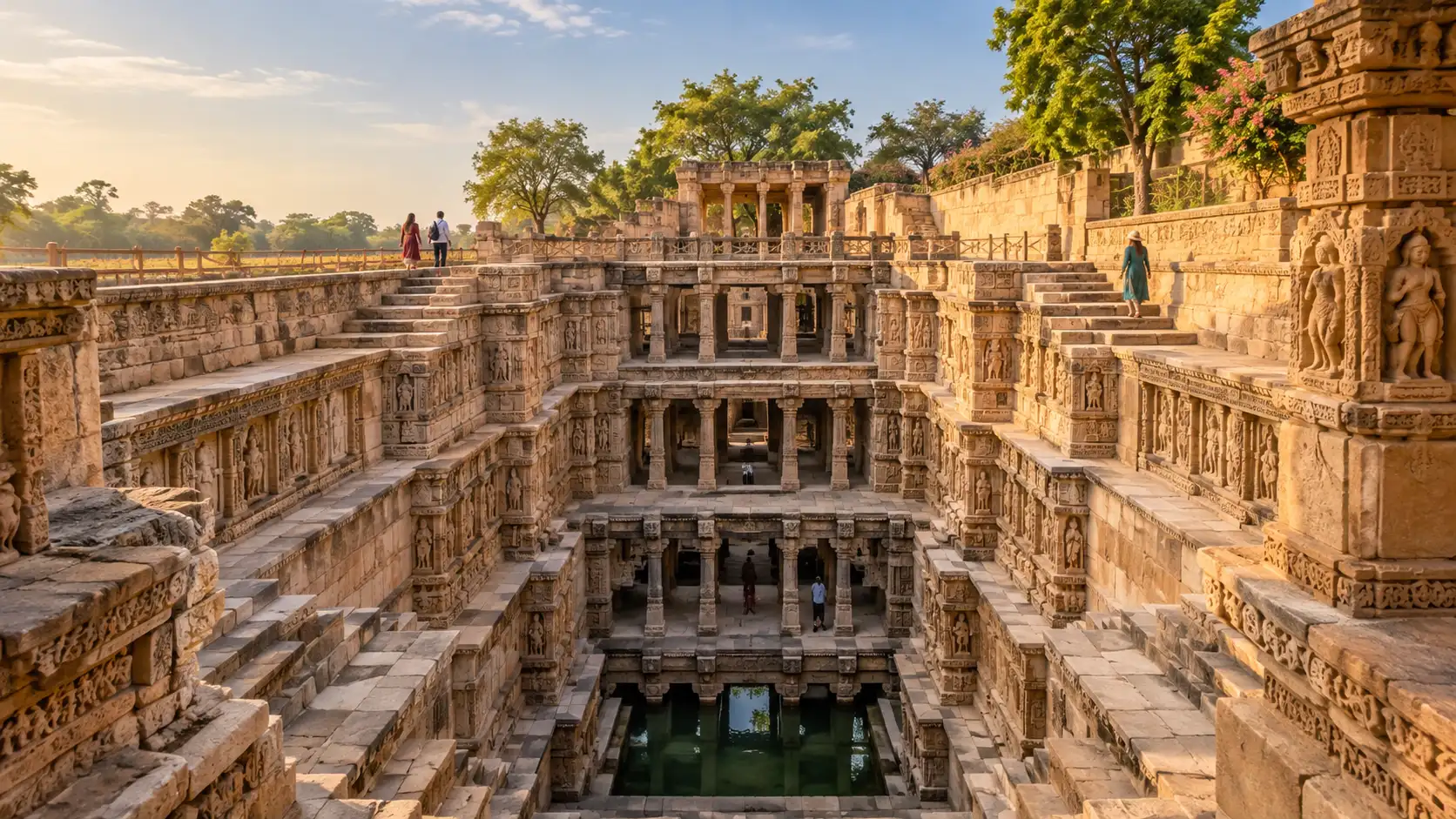
Rani ki Vav is the most widely recognised stepwell in India and a UNESCO World Heritage Site. Commissioned in the eleventh century on the banks of the Saraswati, it is organised as a long subterranean passage with multiple levels, pavilions and thousands of sculptural elements. Its architecture is often read from the top down: the deeper you go, the more the structure reveals its scale and iconography.
Give yourself time to look beyond the central stairs. The side walls, pillars and recessed figures show how water architecture could also carry stories, symbolism and royal patronage. Visit early in the day for softer light and fewer crowds, and follow the site’s instructions around photography, barriers and conservation areas.
Chand Baori, Abhaneri, Rajasthan
Chand Baori is known for its dramatic geometry: a vast triangular pattern of stairs drops towards the water on three sides, while pillared galleries occupy the fourth. The repeated lines are striking from the viewing platform, but the monument is also a reminder that the visual order came from an everyday need to reach water at different levels.
Chand Baori is near Abhaneri, making it a practical stop on a route between Jaipur and eastern Rajasthan. Combine it with nearby heritage sites rather than treating the visit as a quick photo stop. The stone can become extremely hot, so carry water, wear sun protection and avoid climbing on closed or unstable sections.
Adalaj Stepwell, near Ahmedabad, Gujarat
Adalaj Stepwell, also called Rudabai Stepwell, is celebrated for its carved columns, balconies and transition between bright surface light and the cooler interior. Its five levels are arranged around a central opening, creating changing views as visitors descend. The structure reflects the meeting of regional building traditions and the practical importance of water in a semi-arid landscape.
Adalaj is easy to combine with an Ahmedabad heritage itinerary. Go in the morning or late afternoon, when the approach is more comfortable, and allow time to observe the ventilation, shadow and stonework rather than rushing through the entrance. Local access rules can change during restoration, so check before you go.
Toor Ji Jhalra, Jodhpur, Rajasthan
Toor Ji Jhalra is a restored eighteenth-century stepwell in the old city of Jodhpur. Unlike the monumental scale of Rani ki Vav or Chand Baori, it sits within an active urban neighbourhood. That setting makes it useful for understanding stepwells as part of living city infrastructure rather than isolated ruins.
The well is close to Jodhpur’s old-city lanes and can be visited alongside Mehrangarh Fort and the blue-city neighbourhoods. Be considerate of residents, keep walkways clear and avoid turning a community space into a loud photo set. The most rewarding details are often the proportions of the steps and the way the surrounding buildings frame the well.
Panna Meena ka Kund, Amer, Rajasthan
Panna Meena ka Kund is a compact, symmetrical water tank near Amer. Its alternating staircases create a crisp geometric pattern and show how a smaller structure could still be carefully planned for access, shade and social use. Because it is close to Jaipur’s major attractions, it is an easy addition to a city heritage day.
Do not treat the stairs as a performance space. Some routes may be restricted or unsafe, especially after rain. Follow local instructions, photograph from permitted areas and leave the site clean. The best visit is one that notices the engineering without ignoring the neighbourhood around it.
Other stepwells and baolis to explore
India has many more examples, and our History & Heritage collection has more context, including Agrasen ki Baoli in Delhi, Dada Harir ni Vav in Ahmedabad, Navlakhi Vav in Vadodara and the stepwells of Bundi. Their forms vary by region, date, material and patron. Some are formal monuments; others are modest structures embedded in villages and historic streets.
Before adding a lesser-known baoli to an itinerary, verify that it is open, safe and appropriate for visitors. A site appearing on a map is not automatically a maintained tourist attraction. Ask local authorities or a reputable heritage organisation about access, conservation work and photography rules.