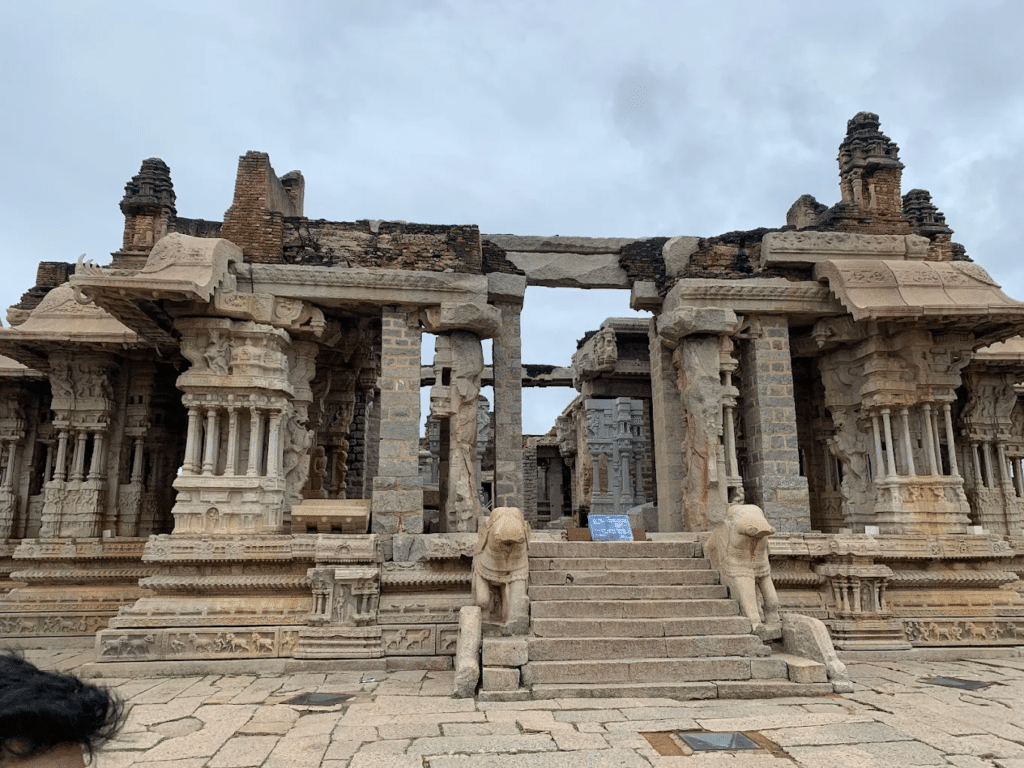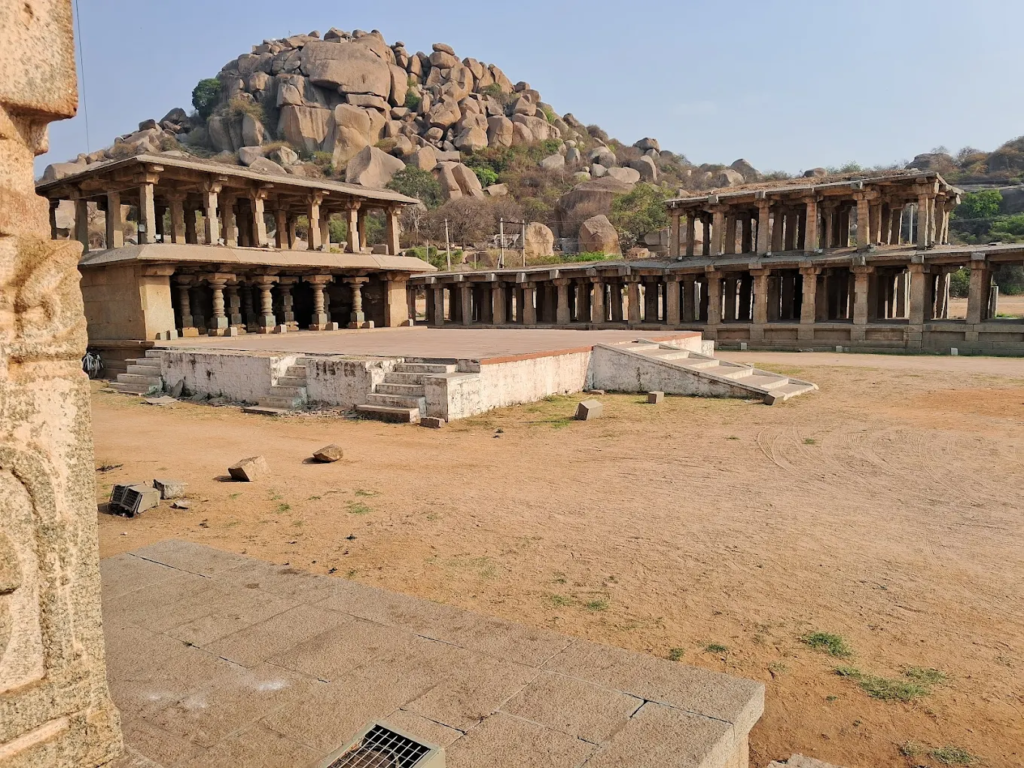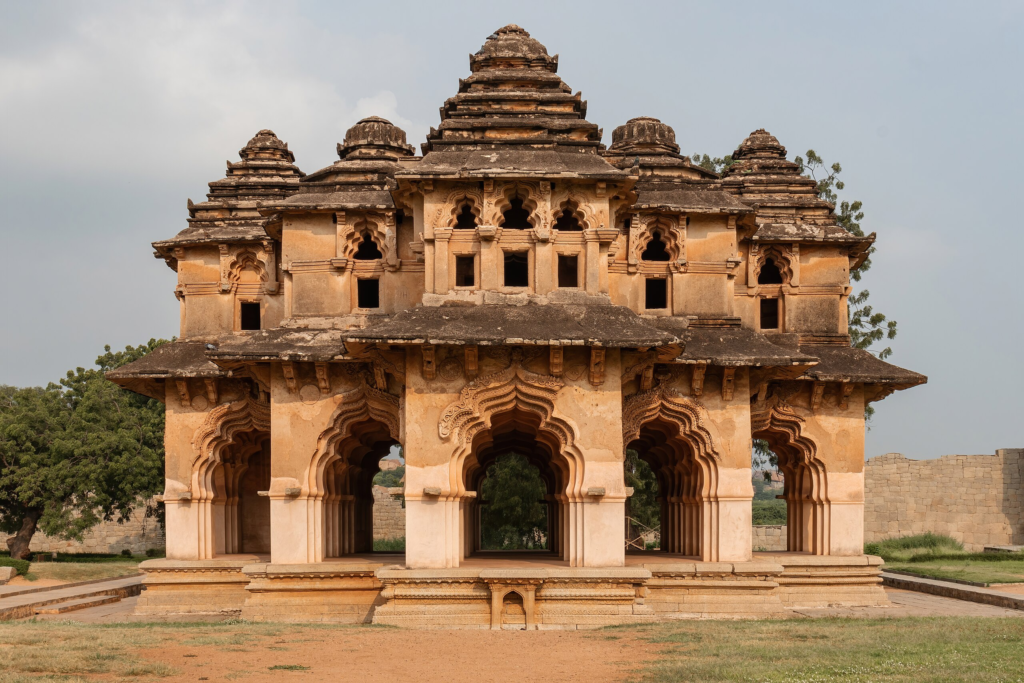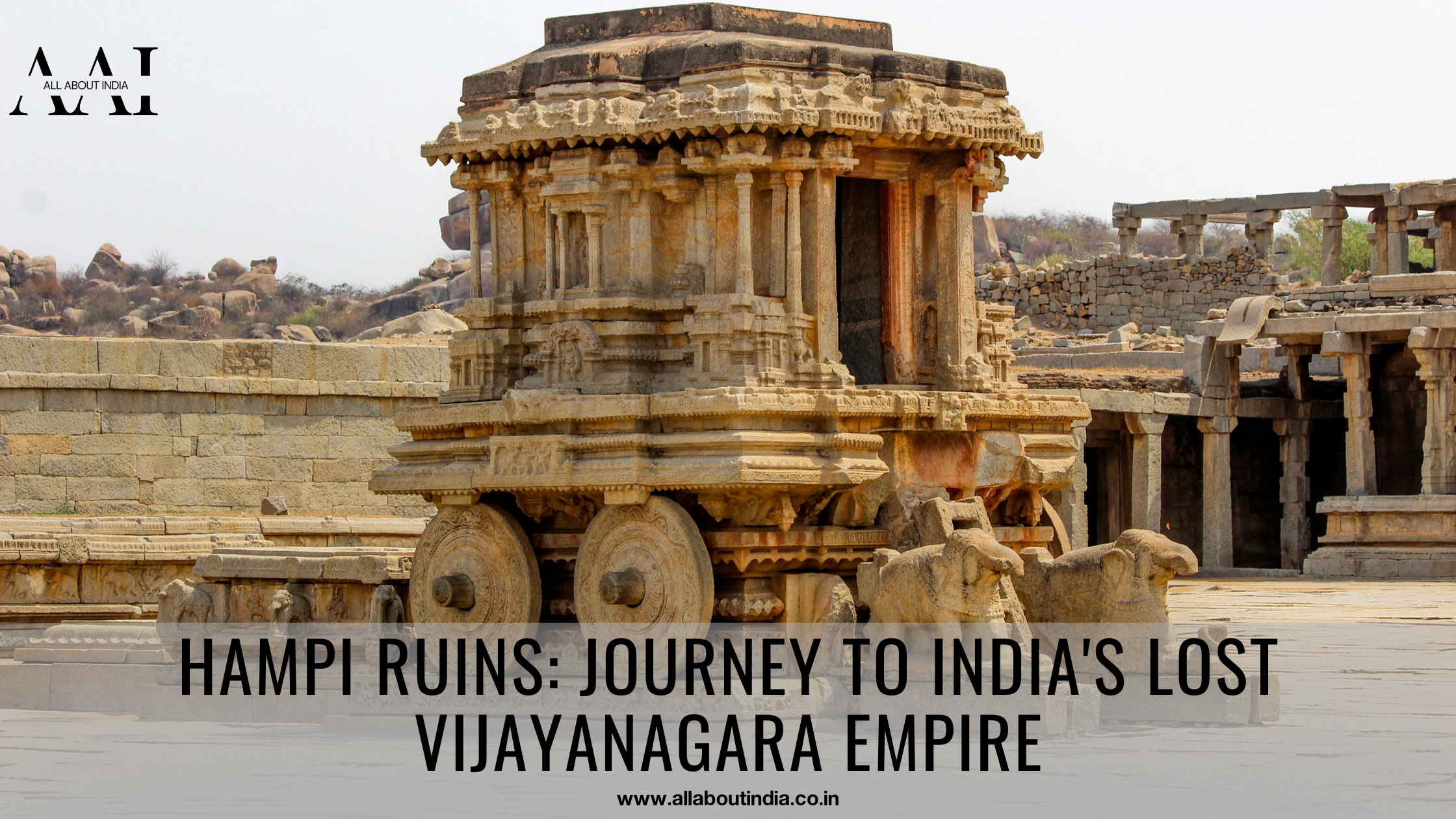
Imagine standing amidst a landscape that seems plucked from mythology—massive granite boulders stacked impossibly upon each other, creating surreal formations that dwarf the human scale. Between these ancient stones lie the scattered remnants of what was once the world’s second-largest city after Beijing, a metropolis so wealthy that foreign travelers called it “one of the most beautiful cities” they had ever seen. Welcome to the Hampi ruins, where the magnificent Vijayanagara Empire’s glory still echoes through over 1,600 surviving monuments spread across 4,100 hectares of otherworldly terrain.
The Hampi ruins tell one of history’s most dramatic stories—of an empire that ruled South India for over two centuries, amassed unimaginable wealth, built architectural marvels that still astound engineers today, and then fell spectacularly in a single devastating battle that left its capital pillaged and abandoned. Today, this UNESCO World Heritage Site stands as a hauntingly beautiful testament to human ambition, artistic achievement, and the impermanence of even the mightiest civilizations.
Whether you’re a history enthusiast drawn to tales of forgotten empires, an architecture lover fascinated by ancient engineering marvels, a photographer seeking surreal landscapes unlike anywhere else on Earth, a spiritual seeker exploring India’s sacred geography, or an adventurer wanting to explore one of Asia’s most spectacular archaeological sites, the Hampi ruins offer an experience that transcends ordinary tourism—a journey through time that will fundamentally alter your understanding of India’s cultural richness and historical depth.
The Rise of Vijayanagara: From Ashes to Glory
Every great empire has its founding myth, and the story of Vijayanagara and the subsequent Hampi ruins we see today begins with destruction, devotion, and remarkable vision.
The Fall of Kampili and Seeds of Empire
In the early 14th century, the Deccan plateau of South India was a patchwork of kingdoms constantly threatened by invasions from Delhi Sultanate armies pushing southward. The Kampili kingdom, located in present-day northern Karnataka, stood as one of the last Hindu strongholds resisting Muslim expansion into South India.
In 1327, the armies of Muhammad bin Tughlaq, the Sultan of Delhi, besieged Kampili’s capital, which stood approximately 33 kilometers from what would become Hampi. As defeat became inevitable, the kingdom’s soldiers prepared for a final stand while the women of the royal court performed jauhar—ritual mass suicide to avoid capture and dishonor. The Kampili kingdom fell, its royal line ended, and the region came under Delhi Sultanate control.
Among the Kampili army survivors were two brothers, Harihara and Bukka, who would transform this catastrophic defeat into the foundation of South India’s greatest empire. According to historical accounts, these brothers were captured and taken to Delhi, where they were converted to Islam and employed in the Sultanate’s service. However, their hearts remained in their homeland and with their original faith.
The Vision of Vidyaranya and the Birth of an Empire
Around 1336, Harihara and Bukka managed to escape Delhi and return to their homeland in the Tungabhadra River region. Here, they met Sage Vidyaranya, a revered Hindu scholar and spiritual leader from the powerful Sringeri Sharada Peetham monastic order. Vidyaranya had a grand vision—to establish a strong Hindu kingdom that could resist further Islamic invasions and protect South Indian culture, temples, and traditions.
Under Vidyaranya’s guidance and blessings, the brothers reconverted to Hinduism and founded the Vijayanagara Empire in 1336. The empire’s name, meaning “City of Victory,” reflected both their triumph over adversity and their determination to protect dharma (righteous duty) against external threats.
The brothers chose Hampi as their capital for strategic and spiritual reasons. The location, on the south bank of the Tungabhadra River, offered natural protection—surrounded by rocky hills providing excellent defensive advantages. Additionally, the site had ancient religious significance, mentioned in Hindu texts as Pampa Kshetra, associated with goddess Pampa and believed to be the mythical Kishkindha where Lord Rama met Hanuman in the Ramayana epic. This connection to sacred geography lent spiritual legitimacy to their new empire.
The Empire’s Spectacular Growth
What began as a small kingdom around Hampi rapidly expanded under successive rulers into one of South India’s most powerful empires. The Vijayanagara Empire at its peak controlled virtually all of peninsular India south of the Krishna River—encompassing most of modern-day Karnataka, Andhra Pradesh, Tamil Nadu, and Kerala, as well as parts of Goa and Maharashtra.
The empire’s military prowess was legendary. Historical records describe armies numbering over one million soldiers, including cavalry, infantry, and war elephants. This massive military machine successfully repelled numerous invasions from the Bahmani Sultanate and later the Deccan Sultanates for over two centuries—an achievement that earned Vijayanagara the title of “the last great Hindu kingdom.”
But military might alone doesn’t explain Vijayanagara’s success. The empire’s rulers were remarkably tolerant and cosmopolitan for their era. While they championed Hindu culture and built magnificent temples, they also employed Muslims in high administrative and military positions, welcomed foreign traders regardless of religion, and patronized diverse artistic and architectural traditions. This openness created a cultural melting pot that attracted merchants, artists, scholars, and travelers from across Asia, Europe, and the Middle East.
The Golden Age Under Krishnadevaraya
The Vijayanagara Empire reached its zenith under Krishnadevaraya (r. 1509-1529), considered one of the greatest rulers in Indian history. A brilliant military strategist, accomplished poet, patron of arts, and effective administrator, Krishnadevaraya expanded the empire to its greatest territorial extent and transformed Hampi into a dazzling capital that rivaled any city in the world.
Contemporary accounts from Portuguese and Persian travelers describe Vijayanagara-Hampi during Krishnadevaraya’s reign in almost mythical terms:
- The city stretched for miles, with elaborate fortifications featuring seven concentric defensive walls
- The bazaars were so long that a person could barely see from one end to the other
- Merchants from Persia, Portugal, China, Africa, and Arabia conducted business in dozens of languages
- The royal treasury overflowed with gold, diamonds, rubies, and pearls
- The palace complex featured decorated halls, audience chambers, pleasure gardens, and luxurious zenana (women’s quarters)
- Temples were adorned with gold and precious gems
- The streets were clean, well-organized, and safer than European cities of the same era
Krishnadevaraya himself was a poet who wrote in multiple languages, a warrior who never lost a battle, and a visionary who understood that a great empire needed both military strength and cultural sophistication. His patronage attracted the finest artists, architects, musicians, dancers, and scholars to Hampi, creating a golden age of South Indian art and literature that influenced regional culture for centuries to come.
The Catastrophic Fall: Battle of Talikota
Tragically, Vijayanagara’s glory ended suddenly and violently. By the mid-16th century, the Bahmani Sultanate had fragmented into five independent Deccan Sultanates (Bijapur, Golconda, Ahmednagar, Bidar, and Berar). Despite their constant internal conflicts, these sultanates shared one common concern—the powerful Hindu empire to their south.
In 1565, the five sultanates formed an unprecedented alliance with a single goal: destroy Vijayanagara. The massive combined army, possibly numbering 500,000 soldiers, marched south to meet Vijayanagara forces at Talikota in northern Karnataka on January 23, 1565.
The Vijayanagara army, though also massive and battle-tested, faced several disadvantages. The elderly regent Rama Raya, who ruled in place of the weak emperor Sadasiva Raya, commanded the forces. More critically, the sultanates employed superior artillery and firearms, relatively new military technologies that Vijayanagara had been slower to adopt.
The battle initially favored Vijayanagara, with their war elephants and cavalry pushing back the sultanate forces. Victory seemed within grasp until disaster struck—two Muslim generals in the Vijayanagara army, the mercenary Gilani brothers according to some accounts, suddenly switched sides and joined the sultanates. This treacherous move created chaos in Vijayanagara ranks.
The sultanate forces quickly capitalized on the confusion, capturing Rama Raya and beheading him. His severed head was stuffed with straw and paraded before both armies. The sight of their commander’s head destroyed Vijayanagara morale. The army collapsed into panicked retreat, suffering devastating casualties.
The Pillaging of Hampi
What followed was one of history’s most thorough destructions of a capital city. The victorious sultanate armies marched to Hampi and systematically pillaged it for six months. They looted the palaces, temples, and treasury, carrying away unimaginable wealth. More tragically, they deliberately destroyed much of the city’s cultural heritage:
- Temple towers and sanctums were desecrated or demolished
- Massive stone sculptures were smashed or defaced
- Buildings were set ablaze
- The irrigation systems and water infrastructure were destroyed
- Libraries and manuscripts were burned
The destruction was so complete that Hampi was abandoned shortly after. The surviving members of the royal family fled south and attempted to reestablish the empire at Penukonda and later other locations, but Vijayanagara never recovered its former glory. The empire limped along in diminished form until finally dissolving completely in 1646.
When Italian merchant Cesare Federici visited Hampi a few decades after its fall, he wrote: “the citie of Bezeneger (Hampi-Vijayanagara) is not altogether destroyed, yet the houses stand still, but emptie, and there is dwelling in them nothing, as is reported, but Tygres and other wild beasts.” The magnificent capital had become a ghost city haunted by memories of its vanished glory.