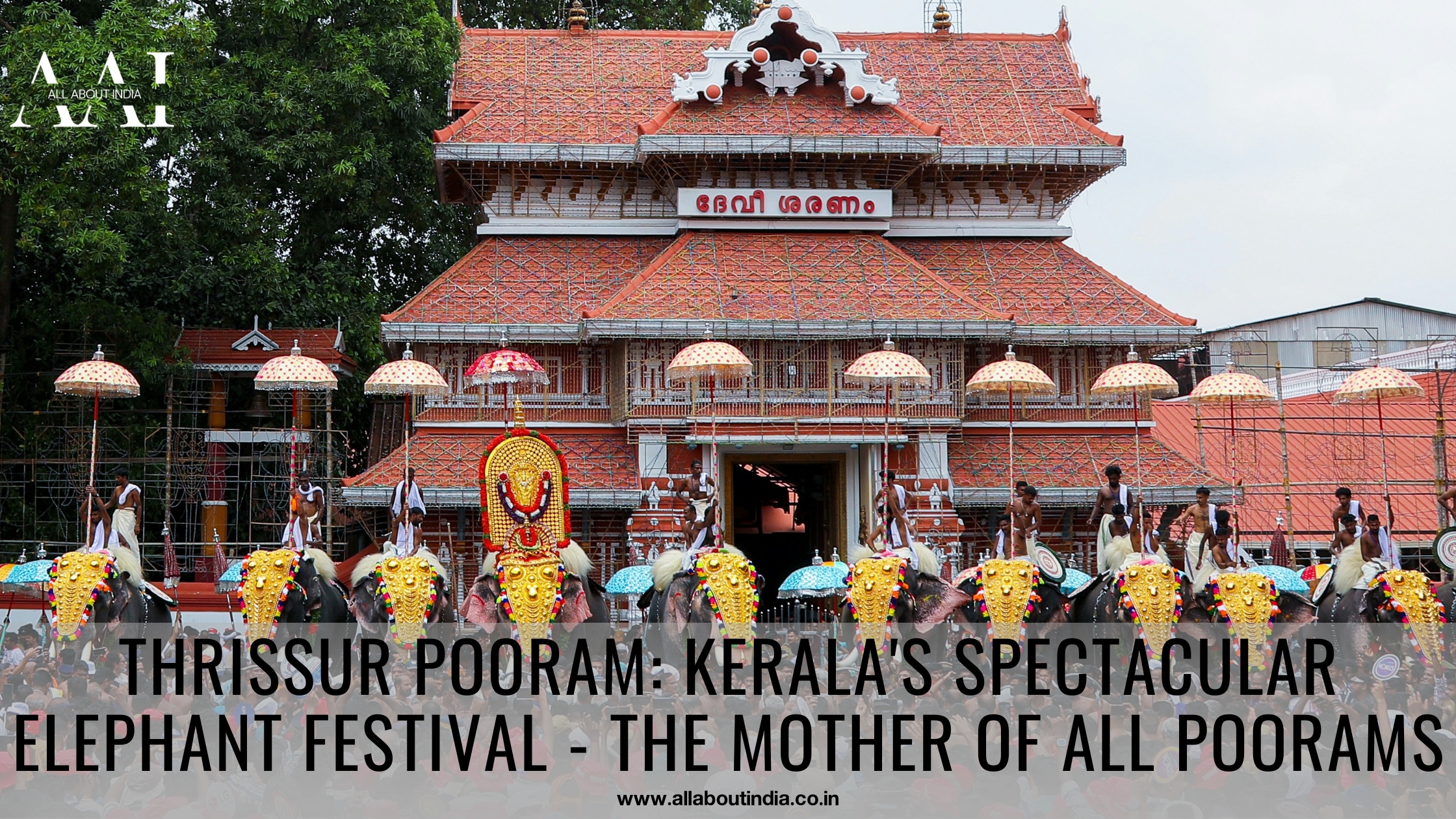
Imagine standing in the heart of Kerala’s cultural capital as the afternoon sun blazes overhead. Before you, 30 magnificently decorated elephants stand in two facing rows, their golden caparisons gleaming, peacock-feather fans swaying gently in the breeze. Atop each majestic tusker, handlers prepare for the most anticipated moment—Kudamattam, the spectacular rapid-fire exchange of brilliantly colored umbrellas that has captivated millions for over two centuries.
The air throbs with the thunderous rhythm of hundreds of drums—the iconic Ilanjithara Melam, where traditional percussion instruments create a sonic experience so powerful it reverberates through your chest. Around you, nearly one million people have gathered at the Thekkinkadu Maidan, their collective energy creating an atmosphere electric with anticipation, devotion, and celebration.
This is Thrissur Pooram—the “Mother of All Poorams,” Kerala’s grandest temple festival, and one of Asia’s largest and most spectacular cultural gatherings. For 36 hours non-stop, this extraordinary event transforms the usually peaceful city of Thrissur into the epicenter of color, sound, tradition, and magnificent elephants. Thrissur Pooram isn’t just a festival; it’s a cultural phenomenon that showcases Kerala’s rich heritage through decorated elephant processions, world-class traditional music ensembles, friendly temple rivalries that bring out the best in participants, and pyrotechnic displays that rank among India’s most spectacular.
Whether you’re a culture enthusiast wanting to witness authentic Kerala traditions, a photography lover seeking visual magnificence, an elephant admirer drawn to these gentle giants in their finest regalia, a festival traveler searching for unique experiences, or simply someone captivated by spectacular celebrations, Thrissur Pooram offers an unforgettable journey into the soul of God’s Own Country.
The History: How Thrissur Pooram Began
Every great festival has an origin story, and Thrissur Pooram boasts one of the most fascinating in Indian cultural history—born from royal intervention to solve a temple dispute that had angered an entire city.
The Arattupuzha Incident of 1796
In the late 18th century, the most important pooram (temple festival) in Kerala was held at Arattupuzha, about 12 kilometers from Thrissur. Temples from across the region, including several from Thrissur, participated in this prestigious annual gathering. The festival required temples to bring their deities in grand processions to pay obeisance to the presiding deity at Arattupuzha Temple.
In 1796, the Kerala monsoon arrived with unusual fury. Incessant rains lashed the region for days, turning roads into rivers and making travel treacherous. The temple groups from Thrissur—including Paramekkavu, Thiruvambadi, Chembukavu, Karamukku, Laloor, Ayyanthole, and others—struggled through the downpour to reach Arattupuzha on time.
Despite their best efforts, the Thrissur contingent arrived late. To their shock and humiliation, the Arattupuzha temple authorities refused them entry to the main pooram proceedings. The doors were closed, the ceremonies had begun without them, and no accommodation would be made for the delayed temples. This rejection was not just a logistical inconvenience—it was a profound insult to the deities, the priests, and the entire Thrissur community.
Enter Sakthan Thampuran: The Visionary King
The embarrassed and angered temple groups returned to Thrissur and complained to their ruler, Raja Rama Varma, popularly known as Sakthan Thampuran (meaning “powerful ruler”). This extraordinary king, who ruled the Cochin kingdom from 1790 to 1805, was known for his firm, decisive administration, progressive policies, and genuine concern for his people’s dignity.
Sakthan Thampuran was not a ruler to accept such disrespect to his city’s temples. Rather than simply complaining to Arattupuzha authorities or seeking revenge through political means, he conceived a brilliant solution: create an even grander pooram right in Thrissur itself—one that would not only restore the dignity of the slighted temples but would eventually surpass the Arattupuzha Pooram in magnificence and become Kerala’s premier temple festival.
The Birth of Thrissur Pooram in 1798
In 1798, Sakthan Thampuran implemented his vision. He unified the ten temples situated around the Vadakkunnathan Temple in the heart of Thrissur and organized the first Thrissur Pooram as a mass festival. The king personally planned the festival’s structure, events, and traditions with remarkable foresight and attention to detail.
His masterstroke was to divide the ten participating temples into two groups, creating a friendly rivalry that would inspire each side to present their finest offerings:
The Western Group (Thiruvambadi Side): Led by the Thiruvambadi Sri Krishna Temple, this faction included:
- Thiruvambadi Kavu (Sri Krishna Temple) – Leader
- Kanimangalam Sastha Temple
- Laloor Bhagavathy Temple
- Ayyanthole Bhagavathy Temple (Sree Karthyayani Temple)
- Nethilakkavu Bhagavathy Temple
The Eastern Group (Paramekkavu Side): Led by the Paramekkavu Bhagavathy Temple, this faction comprised:
- Paramekkavu Bhagavathy Temple – Leader
- Pookattikkara-Karamukku Bhagavathy Temple
- Chembukavu Bhagavathy Temple
- Choorakkottukavu Bhagavathy Temple
- Panamukkumpilly Sastha Temple
The Thrissur Pooram was centered around the Vadakkunnathan Temple—an ancient shrine dedicated to Lord Shiva (Vadakkunnathan), situated on a hillock in the city center surrounded by the sprawling Thekkinkadu Maidan. All temple groups would bring their deities in grand processions to pay obeisance to Lord Shiva, the presiding deity.
What made Sakthan Thampuran’s festival revolutionary was its secular and inclusive nature. Unlike many temple festivals that excluded certain communities, Thrissur Pooram from its inception welcomed participation from all sections of society regardless of caste, religion, or social status. The king specifically designed it to be a people’s festival—”Poorangalude Pooram” (the Festival of Festivals) that belonged to everyone.
A Festival Born of Necessity, Perfected by Vision
The genius of Sakthan Thampuran lay not just in creating an alternative to Arattupuzha Pooram, but in designing a festival structure so perfect, so engaging, and so spectacular that it would endure for centuries. He incorporated elements that would appeal to every sensibility:
- Religious devotion through traditional temple rituals
- Aesthetic beauty through decorated elephants and ornate umbrellas
- Musical excellence through extended percussion ensembles
- Competitive spirit through the friendly rivalry between temple groups
- Pyrotechnic spectacle through innovative fireworks displays
- Community participation through open access for all people
Within a few years, Thrissur Pooram had eclipsed the Arattupuzha Pooram in popularity and grandeur. What began as an act of defiance against disrespect had blossomed into Kerala’s most magnificent cultural celebration. Over two centuries later, the festival continues to follow the structure laid out by Sakthan Thampuran with remarkable fidelity, a testament to his vision and planning.
Thrissur Pooram 2026: Dates and Festival Schedule
Thrissur Pooram follows the traditional Malayalam calendar and is celebrated on the Pooram day (when the moon rises with the Pooram nakshatra/star) in the month of Medam, typically falling in late April or early May.
Thrissur Pooram 2026 Dates
Primary Festival Day: The exact date for Thrissur Pooram 2026 will be announced according to the Malayalam calendar (expected to be in late April or early May 2026). The festival spans seven days, with the main events concentrated in the final 36 hours.
Festival Timeline:
- Day 1 (Seven days before Pooram): Kodiyettam (Flag Hoisting) marks the official start
- Day 4: Sample Vedikettu (Sample Fireworks Display) at Swaraj Round
- Day 6: Main Pooram Day begins with Khadaka Poorangal in early morning
- Day 7: Final ceremonies, Pakal Pooram, and grand fireworks
Detailed Day-by-Day Schedule
Seven Days Before Pooram (Kodiyettam): The Thrissur Pooram festival officially begins with Kodiyettam—the ceremonial flag hoisting at the participating temples, primarily at Thiruvambadi and Paramekkavu temples. This ritual, performed between 11:00 AM and 11:30 AM, signifies the commencement of festival preparations and creates anticipation across the city.
Four Days Before Pooram (Sample Vedikettu): At 7:15 PM, both Thiruvambadi and Paramekkavu Devaswoms present a one-hour Sample Fireworks Display at Swaraj Round. This preview showcases innovative patterns and varieties of fireworks that will be featured in the main display, building excitement among enthusiasts.
Three Days Before Pooram (Exhibition Displays): The Paramekkavu Devaswom exhibits elephant caparisons, ornate umbrellas, and decorative items at Agrasala in Thrissur City. Simultaneously, Thiruvambadi Devaswom displays their caparisons at Church Mission Society High School. These exhibitions allow the public to appreciate the extraordinary craftsmanship before the festival.
Main Pooram Day Schedule:
6:00 AM – Khadaka Poorangal (Subsidiary Processions): The day begins with the arrival of processions from eight subsidiary temples. Each temple brings its deity accompanied by decorated elephants and traditional music, setting the stage for the grand spectacle to follow.
7:00 AM – Entry of Kanimangalam Sastha: The ceremonious entry of Kanimangalam Sastha marks an important milestone in the day’s proceedings.
10:00 AM – Processions Arrive: Deities from all associated temples arrive at the Thekkinkadu Maidan, taking their designated positions around the Vadakkunnathan Temple.
11:00 AM – Madhathil Varavu: This spectacular Panchavadyam melam (five-instrument ensemble) involves more than 200 artists performing with thimila, madhalam, trumpet, cymbal, and edakka. The synchronized performance, lasting over an hour, is a feast for the ears and showcases Kerala’s percussion heritage at its finest.
2:00 PM – Ilanjithara Melam: Perhaps the most iconic musical event of Thrissur Pooram, the Ilanjithara Melam begins inside the Vadakkunnathan Temple courtyard near the sacred Ilanji tree (bullet wood tree). This powerful assembly of percussion artists—featuring chenda (drums), kombu (trumpets), kuzhal (pipes), and elathalam (cymbals)—creates a thunderous, hypnotic rhythm that gradually builds in intensity over 2-3 hours. The performance is so powerful that it can be heard across the city, and the synchronized drumming creates a trance-like state among both performers and audience.
4:00 PM – Thekkottirakkam (Southern Gate Procession): The Paramekkavu Bhagavathy arrives atop the famous tusker Guruvayur Nandan through the southern gate, accompanied by approximately 15 magnificently decorated elephants.
5:30 PM – Kudamattam Preparation: Both Paramekkavu and Thiruvambadi groups enter the Vadakkunnathan Temple through the western gate and emerge through the southern gate, positioning their elephants face-to-face in two parallel rows for the most anticipated event of the festival.
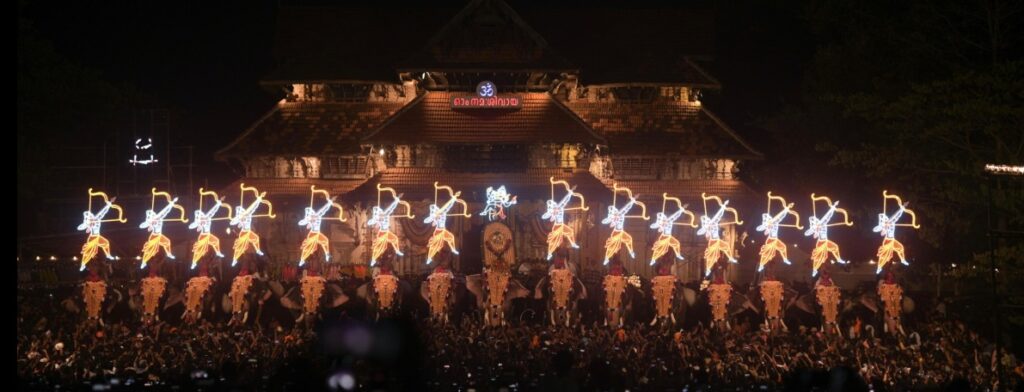
6:00 PM – Kudamattam (Umbrella Exchange): For the next 90-120 minutes, the two groups engage in the spectacular Kudamattam ceremony—the rapid, competitive exchange of colorful, intricately designed parasols atop the elephants. Each group displays over 700-800 umbrellas in quick succession, with increasingly elaborate and creative designs. The crowd roars with appreciation for particularly beautiful or innovative umbrellas. This visual spectacle, combining traditional craftsmanship, vibrant colors, and the majesty of decorated elephants, represents the pinnacle of Thrissur Pooram’s aesthetic appeal.
8:00 PM – Kudamattam Conclusion: As darkness falls and the final umbrellas are displayed, the crowd’s energy reaches fever pitch. The elephants, draped in their finest caparisons with nettipattam (golden headdresses) gleaming under lights, create an unforgettable sight.
10:30 PM – Evening Panchavadyam: Paramekkavu presents another Panchavadyam performance, while Thiruvambadi repeats its Madhathil Varavu. These nighttime performances, illuminated by traditional lights and electric illuminations, create a magical atmosphere.
Final Day Schedule:
3:00 AM – Main Fireworks (Vedikettu): In the pre-dawn darkness, the grand fireworks display begins—one of the largest and most spectacular in India. Both Thiruvambadi and Paramekkavu compete to present the most impressive pyrotechnics, with massive crackers, colorful aerial displays, and innovative patterns lighting up the sky above Thekkinkadu Maidan. The display lasts 2-3 hours, with the sound reverberating across the city and the colors painting the sky in brilliant hues.
8:00 AM – Pakal Pooram (Day Pooram): After the fireworks conclude and a brief rest, the Pakal Pooram ceremony begins. This daytime event features another procession of elephants and traditional performances in the morning light.
12:00 PM – Upacharam Cholli Piriyal (Farewell Ceremony): At noon, the festival concludes with this farewell ceremony at Swaraj Round. The idols of Thiruvambadi Sri Krishna and Paramekkavu Bhagavathy are ceremoniously taken from Swaraj Round back to their respective temples. This marks the official end of Thrissur Pooram for another year, though memories of the spectacle will linger far longer.
3:00 PM – Pakal Vedikkettu (Day Fireworks): A final daytime fireworks display provides a spectacular conclusion to the festival.
The Magnificent Elephants: Living Symbols of Majesty
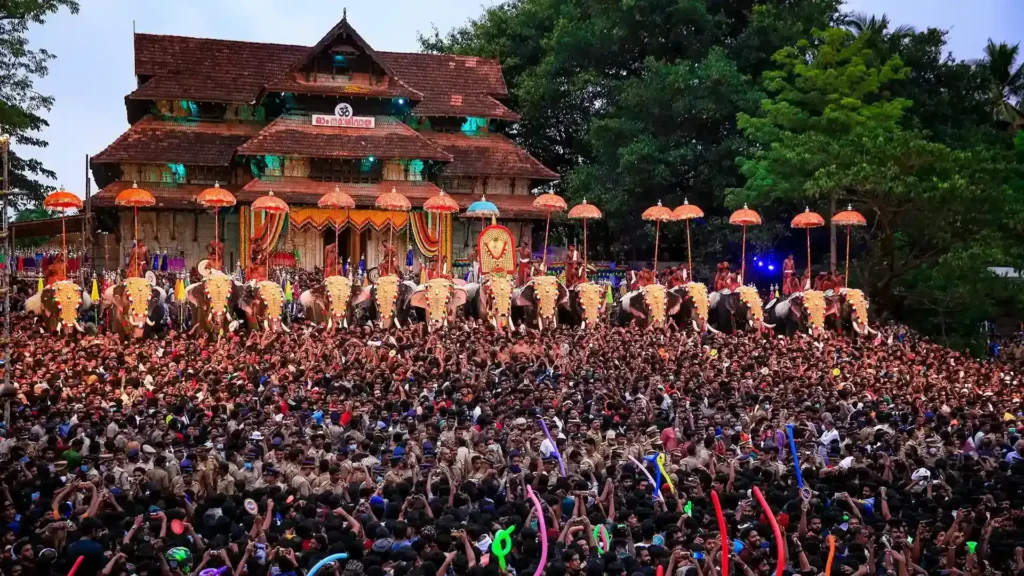
At the heart of Thrissur Pooram stands Kerala’s most beloved and revered animal—the elephant. These gentle giants, adorned in their finest regalia, transform from working animals into living works of art, embodying the grandeur and cultural heritage of Kerala.
The Star Tuskers of Thrissur Pooram
Not all elephants participate in Thrissur Pooram—only the finest, most well-trained, and temperamentally suitable tuskers receive the honor. Some elephants have achieved celebrity status, with dedicated followings among festival enthusiasts:
Thechikottukavu Ramachandran: Standing at 3.16 meters (10 feet 4 inches), Ramachandran is one of the tallest and most famous temple elephants in Kerala. Born around 1963-64, this magnificent tusker has participated in numerous Thrissur Pooram festivals, typically carrying the idol of Chembukavu Bhagavathy. His imposing presence, majestic gait, and calm demeanor make him a crowd favorite. Ramachandran’s arrival at the festival grounds creates waves of excitement among attendees.
Guruvayur Nandan: Belonging to the famous Guruvayur Devaswom, Nandan regularly carries the idol of Paramekkavu Bhagavathy during the Ilanjithara Melam and Kudamattam ceremonies. Known for his steady temperament and regal bearing, Nandan has been a fixture at Thrissur Pooram for years.
Thiruvambady Chandrasekhar: This tusker traditionally carries the idol of Thiruvambady Bhagavathy during Kudamattam and Madhathil Varavu. Chandrasekhar is known for his perfect timing and ability to remain calm despite the massive crowds and thunderous drumming.
Ernakulam Sivakumar: A relatively younger participant, Sivakumar’s ceremonial entry through the southern gopuram on the day before the main Pooram marks a significant moment. His participation represents the inclusion of newer generation elephants in this ancient tradition.
Over 50 elephants typically participate in Thrissur Pooram, with 30 taking center stage during Kudamattam (15 each from Paramekkavu and Thiruvambadi). The remaining elephants participate in subsidiary processions and support roles, creating a spectacular assembly of these magnificent creatures.
The Art of Elephant Decoration
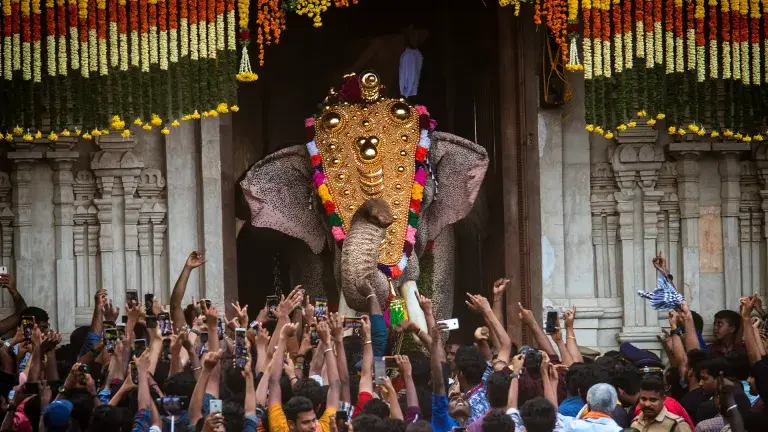
The transformation of elephants into living masterpieces for Thrissur Pooram requires months of preparation and extraordinary craftsmanship. Every decorative element is crafted fresh each year, making each festival unique:
Nettipattam (Golden Headdress): The most iconic element of elephant decoration, the Nettipattam is an ornate golden headdress that covers the elephant’s forehead. Weighing several kilograms and crafted from gold-plated metal, each Nettipattam features intricate designs including deities, floral patterns, and geometric motifs. The craftsmanship required to create these headdresses is so specialized that only a handful of artisans possess the traditional skills.
Chamayam (Body Caparison): Colorful cloths and decorative panels cover the elephant’s body, featuring elaborate designs, mirror work, and embroidery. The Chamayam includes layers of fabrics in vibrant colors—typically reds, oranges, yellows, and purples—creating a stunning visual effect when multiple elephants stand together.
Kolam (Decorative Face Painting): Elephants’ faces are painted with natural dyes in traditional patterns—geometric designs, religious symbols, and artistic flourishes that enhance their features and create distinctive looks for each tusker.
Decorative Bells: Multiple tiers of bells in varying sizes are attached around the elephants’ necks and bodies. These bells create a melodious jingling sound with every movement, adding an auditory dimension to the visual spectacle.
Aalavattom (Peacock Feather Fans): Large, ornamental fans made from peacock feathers mounted on decorated poles are positioned behind the elephants, creating a spectacular backdrop. These fans, reaching 3-4 meters in height, sway gently and create beautiful visual effects.
Venchamarom (Royal Fans): White, ornate fans symbolizing royalty are also positioned around the elephants, adding to the regal atmosphere.
Muthukkuda and Decorative Umbrellas: The centerpiece of Thrissur Pooram’s visual identity—elaborate umbrellas in countless designs—are mounted atop the elephants. These umbrellas range from traditional designs featuring temple motifs to innovative contemporary creations incorporating LED lights, moving elements, and creative themes.
Elephant Welfare at Thrissur Pooram
The welfare of elephants participating in Thrissur Pooram has become an increasingly important consideration in recent years. Temple authorities and the Kerala Forest Department implement several measures:
- Health Checks: All elephants undergo thorough veterinary examinations before being permitted to participate
- Rest Periods: Scheduled breaks ensure elephants don’t become over-stressed during the long festival
- Hydration and Feeding: Regular water and food are provided throughout
- Shade and Cooling: Arrangements for cooling elephants in the hot weather
- Mahout Training: Handlers receive training in elephant welfare and stress recognition
- Post-Festival Care: Comprehensive health checks after the festival conclude
While concerns about elephant welfare in festivals persist, Thrissur Pooram has made significant strides in ensuring participant elephants are well-cared-for, healthy, and not subjected to cruel treatment.
Kudamattam: The Visual Spectacle of a Lifetime
If Thrissur Pooram has a single defining moment, it’s Kudamattam—the competitive exchange of colorful parasols atop decorated elephants. This ceremony, unique to Thrissur Pooram, represents the festival’s perfect synthesis of art, tradition, competition, and spectacle.
The Meaning and Mechanics of Kudamattam
The term “Kudamattam” derives from two Malayalam words: “Kuda” (umbrella) and “Mattam” (exchange/change). At its core, Kudamattam involves the rapid switching and display of ornate silk umbrellas mounted atop the 30 elephants arranged in two facing rows—15 elephants each from Paramekkavu and Thiruvambadi sides.
What elevates this from simple umbrella display to spectacular ceremony is the speed, coordination, creativity, and competitive spirit involved. Handlers atop the elephants work in perfect synchronization to display umbrellas, switch them rapidly, and present increasingly elaborate designs. The two groups engage in friendly one-upmanship, each trying to showcase more beautiful, more creative, more impressive umbrellas than their rivals.
The Umbrella Artistry
The umbrellas displayed during Kudamattam at Thrissur Pooram are extraordinary works of art, crafted fresh each year by skilled artisans:
Traditional Designs:
- Temple deity representations (Lord Krishna, Lord Ganesha, Lord Shiva)
- Religious symbols (Om, Shiva Lingam, Narasimha)
- Mythological scenes from Hindu epics
- Floral patterns and geometric designs
- Traditional Kerala motifs
Contemporary Innovations: Recent years have seen remarkable creativity in umbrella design:
- LED Umbrellas: Incorporating lighting technology for stunning nighttime effects
- Moving Elements: Umbrellas with mechanical components that create motion
- Thematic Designs: Celebrating current events (Chandrayaan space mission, for example)
- 3D Effects: Creating depth and dimension in umbrella artwork
- Cultural Fusion: Blending traditional and modern aesthetic elements
The Materials: Umbrella makers use:
- High-quality silk in vibrant colors
- Mirror work and embroidery
- Gold and silver thread
- Beadwork and sequins
- Traditional dyes and paints
- Bamboo or metal frames for structure
Each umbrella represents dozens of hours of skilled handwork. Both Paramekkavu and Thiruvambadi typically prepare 700-800 umbrellas for display, creating an inventory of extraordinary artistic creations just for this one ceremony.
The Kudamattam Experience
For spectators, Kudamattam is an overwhelming sensory experience:
Visual: The rapid succession of colorful umbrellas against the backdrop of golden elephant caparisons, peacock feather fans swaying, and nettipattams gleaming creates a kaleidoscope of colors and movement. As dusk falls and lights illuminate the scene, the visual impact intensifies.
Auditory: The Ilanjithara Melam continues in the background, its powerful percussion providing a dramatic soundtrack. The crowd’s reactions—cheers, gasps, and applause for particularly impressive umbrellas—add to the audio landscape.
Emotional: The competitive yet cordial atmosphere, the pride of each group in their artistic creations, the shared appreciation of beauty and craftsmanship, and the sheer spectacle of it all create powerful emotional responses.
The crowd, numbering in tens of thousands packed around the Thekkinkadu Maidan, responds enthusiastically to each umbrella display. Particularly beautiful or innovative umbrellas receive roaring approval. There’s a palpable sense of collective appreciation for the artistry, tradition, and effort that goes into every moment of Kudamattam.
The Friendly Rivalry
What makes Kudamattam special is the spirit in which the competition unfolds. This is rivalry without rancor, competition without animosity. Both Paramekkavu and Thiruvambadi groups genuinely respect each other’s efforts and artistry. The goal is not to defeat the opponent but to inspire each other to greater heights of creativity and excellence.
This friendly competitive spirit, established by Sakthan Thampuran over two centuries ago, continues to define Thrissur Pooram. It’s this balance—serious competition that brings out the best in participants combined with mutual respect and camaraderie—that makes the festival’s competitive elements so engaging rather than divisive.
Ilanjithara Melam: The Sonic Soul of Thrissur Pooram
While Kudamattam captivates the eyes, the Ilanjithara Melam captures the ears and, somehow, the very soul. This percussion ensemble, performed inside the Vadakkunnathan Temple courtyard near the sacred Ilanji tree, is considered one of the finest examples of traditional Kerala percussion music.
The Instruments and Formation
The Ilanjithara Melam features four primary instruments:
Chenda: The backbone of the ensemble, the chenda is a cylindrical drum played with curved sticks. Multiple chenda players—sometimes over 100—create the thunderous base rhythm. The sound of massed chendas is so powerful it seems to make the ground vibrate.
Kombu (Trumpet): Made of curved brass or bronze, the kombu adds melodic elements and harmonic depth to the percussion. Kombu players stand interspersed among the drummers, their bright, penetrating tones cutting through the drum thunder.
Kuzhal (Pipe/Flute): This wind instrument adds higher-register melodies, creating layers of sound that complement the deeper tones of drums and trumpets.
Elathalam (Cymbals): Providing rhythmic punctuation and bright, crashing accents, the elathalam players complete the sonic palette.
The musicians arrange themselves in a specific formation, with drummers at the center, trumpets and pipes flanking them, and cymbal players interspersed throughout. The lead drummer (often a legendary maestro like Peruvanam Kuttan Marar) sets the tempo and signals transitions, with other musicians following his cues with split-second precision.
The Performance Structure
The Ilanjithara Melam typically lasts 2-3 hours, beginning with a slow, measured tempo that gradually builds in intensity. The performance follows a specific rhythmic structure based on seven beats (taal), progressively increasing in speed and complexity.
Opening Phase: The melam begins with a deliberate, almost meditative pace. Each drum stroke is clear and distinct, each trumpet note clearly articulated. This section establishes the foundational rhythm and allows the audience to settle into the sonic experience.
Building Phase: Gradually, almost imperceptibly at first, the tempo increases. The rhythms become more complex, with polyrhythmic patterns emerging. The sonic intensity builds as more instruments join at higher volumes.
Climax Phase: The final section reaches fever pitch. The drumming becomes furious yet remains perfectly synchronized. The accumulated sonic energy feels almost physical—spectators often report feeling the rhythm in their chests and bones. At this peak moment, the 100+ drummers, dozens of trumpet and pipe players, and numerous cymbal players create a wall of sound unlike anything else in the musical world.
Resolution: The melam doesn’t simply end—it resolves. The tempo gradually decreases, the intensity lessens, and the performance comes to a structured conclusion that leaves the audience simultaneously exhilarated and satisfied.
The Spiritual and Cultural Significance
For Keralites, the Ilanjithara Melam is far more than entertainment—it’s a profound cultural and spiritual experience. The performance is considered an offering to Lord Shiva, a sonic prayer that connects heaven and earth.
The musicians, many of whom have trained since childhood in families that have performed this art for generations, approach the performance with deep devotion and seriousness. They’re not simply playing music; they’re participating in a sacred ritual, channeling tradition that stretches back centuries.
For attendees at Thrissur Pooram, the Ilanjithara Melam often represents the festival’s spiritual apex. While Kudamattam dazzles the eyes, the melam touches something deeper—creating a collective trance state, a shared experience of transcendence through sound.
The Spectacular Fireworks: Lighting Up the Kerala Sky
While many festivals feature fireworks, the pyrotechnic displays at Thrissur Pooram have earned legendary status throughout India. These aren’t mere fireworks—they’re competitive art forms, technological showcases, and spectacular conclusions to the festival’s celebration.
The Fireworks Competition
Both Paramekkavu and Thiruvambadi groups compete to present the most impressive fireworks display. Each side invests significant resources in creating innovative pyrotechnic effects, unique patterns, and crowd-pleasing spectacles. Fireworks specialists work year-round designing new effects specifically for Thrissur Pooram.
Sample Vedikettu (Sample Fireworks): Four days before the main Pooram, both groups present a one-hour sample fireworks display at Swaraj Round starting at 7:15 PM. This preview showcases the varieties and innovations that will appear in the main display, building anticipation and allowing fireworks enthusiasts to compare the two groups’ approaches.
Main Vedikettu (Main Fireworks): The grand fireworks display occurs at 3:00 AM on the final day of Thrissur Pooram. In the pre-dawn darkness, the sky above Thekkinkadu Maidan transforms into a canvas of fire and color. The display lasts 2-3 hours, with both groups alternating their presentations.
Pakal Vedikkettu (Day Fireworks): At 3:00 PM on the final day, a daytime fireworks display concludes the festival. While visually less dramatic than nighttime displays, the Pakal Vedikkettu showcases the raw power and sound of pyrotechnics, with massive explosions creating thunderous booms that echo across the city.
Innovations and Spectacle
Thrissur Pooram fireworks are renowned for innovation. Pyrotechnic specialists create:
- Massive aerial shells creating spectacular bursts
- Ground displays with intricate patterns
- Synchronized multi-stage effects
- Color combinations and transitions
- Novel explosion patterns and sequences
- Themed displays incorporating current events or cultural references
The sound is equally important as the visual spectacle. The thunderous booms, rapid-fire crackling, and whistling rockets create an auditory experience that matches the visual magnificence.
Safety and Regulations
Given the scale of the fireworks and the massive crowds, safety is paramount. Authorities implement strict safety protocols, establish exclusion zones, and deploy firefighting equipment. In recent years, concerns about noise pollution, air quality, and elephant welfare have led to discussions about moderating fireworks displays, though they remain an integral Thrissur Pooram element.
Practical Planning Guide: Visiting Thrissur Pooram
Best Time to Visit
Thrissur Pooram occurs in late April or early May, coinciding with Kerala’s hot season. Temperatures during this period typically range from 28-38°C (82-100°F) with high humidity. Despite the heat, over a million people attend, drawn by the festival’s incomparable spectacle.
Weather Considerations:
- Heat: Daytime temperatures are intense. Stay hydrated, use sunscreen, wear light cotton clothing, and seek shade when possible
- Crowds: Expect massive crowds, especially during Kudamattam and Ilanjithara Melam. Arrive early for good viewing positions
- Dust: The Thekkinkadu Maidan can be dusty. Those with respiratory sensitivities should consider masks
How to Reach Thrissur
By Air: Cochin International Airport (Nedumbassery Airport) is the nearest airport, located approximately 55-58 kilometers from Thrissur. This is Kerala’s largest and busiest airport with excellent domestic and international connectivity.
From the airport:
- Taxi/Cab: Pre-paid taxis and app-based services (Ola, Uber) take 1.5-2 hours to reach Thrissur (₹1,200-1,800)
- Bus: Take a bus from the airport to Angamaly or Aluva, then catch another bus to Thrissur (economical but time-consuming)
- Train: Taxi to Angamaly Railway Station, then train to Thrissur (combines cost-effectiveness with comfort)
By Train: Thrissur Railway Station is a major railhead in South India with excellent connectivity to all major Indian cities. Key trains include:
- From Delhi: Kerala Express, Mangala Lakshadweep Express
- From Mumbai: Netravati Express, Mumbai-Kanyakumari Express
- From Bangalore: Kanyakumari Express, Intercity Express
- From Chennai: Chennai-Ernakulam Express
The railway station is centrally located, just 1-2 kilometers from Vadakkunnathan Temple and the festival grounds.
By Road: Thrissur has excellent road connectivity via National Highways NH544, NH47, NH17, and NH66. Options include:
- KSRTC Buses: Kerala State Road Transport Corporation operates regular services from Kochi (65 km), Palakkad (80 km), Kozhikode (140 km), and other Kerala cities
- Private Buses: Numerous private operators run comfortable services
- Car/Bike: Self-drive or hired vehicles offer flexibility. The drive from Kochi takes approximately 1.5 hours
Where to Stay
Accommodation during Thrissur Pooram requires advance booking—ideally 3-6 months ahead. Hotels fill quickly and prices increase significantly during the festival period.
Luxury Hotels:
- Hyatt Regency Thrissur (₹8,000-15,000/night): Premium amenities, excellent service, proximity to venue
- Park Inn by Radisson Thrissur East Fort (₹4,000-8,000/night): 4-star comfort, good food, convenient location
Mid-Range Hotels:
- Hotel Peninsula (₹2,500-4,500/night): 4-minute walk from temple, clean, well-reviewed
- The Garuda Hotel (₹2,000-3,500/night): 6 minutes from venue, comfortable rooms
- Ramada by Wyndham (₹3,000-5,500/night): Modern amenities, central location
Budget Options:
- Hotel Niya Regency (₹1,500-2,500/night): Reliable budget stay, basic but clean
- Itsy Hotels Ammu Regency (₹1,500-2,500/night): 9 minutes from temple, affordable
- Local Guesthouses (₹800-1,500/night): Basic facilities, limited availability
Homestays: Several homestays in Thrissur offer authentic Kerala hospitality at ₹1,200-2,500/night. Book through platforms like Airbnb or local tourism websites.
Pro Tips:
- Stay close to Vadakkunnathan Temple for easy access (walking distance ideal)
- Book immediately after dates are announced
- Confirm bookings multiple times as festival dates approach
- Be prepared for noise—the festival continues through the night
- Some hotels offer rooftop viewing for a premium
Getting Around Thrissur
During Thrissur Pooram:
- Walking: Best option for reaching the festival grounds from nearby hotels. The Thekkinkadu Maidan area becomes pedestrian-only during major events
- Auto-rickshaws: Available but expensive and difficult to find during peak hours. Negotiate fares in advance
- City Buses: Regular services, but extremely crowded during the festival
- Pre-arranged Vehicles: If staying farther away, arrange pick-up/drop-off times with your hotel or a reliable driver
Regular Days:
- Auto-rickshaws are the most convenient local transport (₹20-100 for short distances)
- City buses connect all major areas (₹10-30)
- Bike/scooter rentals available (₹300-500/day)
- App-based cabs operate in Thrissur
What to Bring
Essentials:
- Comfortable walking shoes (you’ll be on your feet for hours)
- Light, breathable cotton clothing (modest—cover shoulders and knees near temples)
- Sun hat, sunglasses, high-SPF sunscreen
- Reusable water bottle (stay hydrated!)
- Small backpack for essentials
- Cash in small denominations (many vendors don’t accept cards)
- Portable phone charger/power bank
- Basic first-aid kit and any personal medications
For Photography:
- Camera with extra batteries and memory cards
- Zoom lens for capturing elephant details from distance
- Wide-angle lens for crowd and procession shots
- Tripod (if you can manage carrying it through crowds)
- Lens cleaning cloth (dust is inevitable)
Optional but Useful:
- Earplugs (the percussion and fireworks are LOUD)
- Dust mask or N95 respirator
- Wet wipes/hand sanitizer
- Snacks (food stalls available but lines are long)
- Foldable chair/mat (if watching from less crowded areas)
Cultural Etiquette and Tips
Respect Sacred Spaces:
- Remove shoes before entering Vadakkunnathan Temple or other temple areas
- Don’t touch or climb on temple structures
- Maintain respectful behavior during religious ceremonies
- Ask permission before photographing priests or rituals
Photography Guidelines:
- Photography is generally allowed in public areas
- DO NOT use flash near elephants (can startle them)
- Be respectful when photographing people—ask permission for close-ups
- Don’t obstruct others’ views while taking photos
- Avoid photographing inside the temple’s inner sanctum
Safety Considerations:
- Stay aware of your surroundings in massive crowds
- Keep valuables secure—pickpockets target festivals
- Establish a meeting point with your group if separated
- Follow police and security instructions
- Stay back from elephants unless directed otherwise by handlers
- During fireworks, maintain safe distances from launch areas
Environmental Responsibility:
- Use dustbins provided or carry trash until you find proper disposal
- Don’t throw plastic or non-biodegradable items on the ground
- The festival generates significant waste—be part of the solution
- Support vendors using eco-friendly packaging
Interacting with Locals:
- Keralites are generally warm and helpful—don’t hesitate to ask for directions
- Learning a few Malayalam phrases is appreciated: “Namaskaram” (hello), “Nanni” (thank you)
- Be patient with crowds and queues
- Respect that this is a deeply meaningful religious and cultural event for locals, not just a tourist spectacle
Food and Dining
Street Food at Thrissur Pooram: Numerous food stalls set up around the festival grounds offering Kerala delicacies:
- Banana chips and Kerala mixture (savory snacks)
- Pazhampori (banana fritters)
- Puttu and kadala curry
- Kerala parottas with curry
- Fresh coconut water
- Sweet kozhukkattas
- Ice cream and cold drinks
Restaurants Near the Festival:
- Sree Radhakrishna Prasada: Vegetarian Kerala meals
- Hotel Bharath: Mixed cuisine, good Kerala options
- Ming Palace: Chinese and Indian
- Hotel Joys Palace: Multi-cuisine
Food Tips:
- Eat freshly cooked food from busy stalls (high turnover = fresher food)
- Drink only bottled water
- Avoid raw salads or pre-cut fruits
- Try traditional Kerala sadhya (feast) if offered
- Keep hand sanitizer handy
Health and Safety
Medical Facilities:
- First aid posts operate at the festival grounds
- Jubilee Mission Medical College & Hospital (major hospital, 5 km from city center)
- Government Medical College Hospital
- Numerous private clinics and pharmacies in the city
Common Issues:
- Heat Exhaustion: Stay hydrated, rest in shade, seek medical help if feeling dizzy or nauseous
- Stomach Issues: Carry ORS packets, anti-diarrheal medication
- Respiratory Problems: Dust and smoke can trigger issues—carry inhalers if asthmatic
- Fatigue: The festival runs 36+ hours—pace yourself, don’t try to see everything
Emergency Contacts:
- Police: 100
- Ambulance: 102 / 108
- Fire: 101
- Tourist Police: Available at major festival locations
Beyond Thrissur Pooram: Other Attractions
If extending your stay in Thrissur, explore these nearby attractions:
Vadakkunnathan Temple: Even outside Pooram time, this ancient Shiva temple (one of Kerala’s oldest) is worth visiting for its stunning architecture, murals depicting Mahabharata scenes, and peaceful atmosphere.
Athirapally Waterfalls: Located 60 km from Thrissur, Kerala’s largest waterfall creates a spectacular 80-foot drop. Often called the “Niagara of India,” it’s surrounded by lush forests and offers stunning natural beauty.
Guruvayur Temple: One of Kerala’s most important Krishna temples, Guruvayur (30 km from Thrissur) attracts millions of devotees annually. The temple complex includes Punnathur Kotta (elephant sanctuary).
Peechi-Vazhani Wildlife Sanctuary: This protected area offers trekking, boating, and wildlife watching opportunities just 20 km from Thrissur city.
Kerala Kalamandalam: This premier institution for Kerala’s traditional arts offers demonstrations of Kathakali, Mohiniyattam, and other classical art forms.
Thrissur Zoo and Museum: Kerala’s oldest zoo and State Museum complex showcases regional wildlife and cultural artifacts.
Basilica of Our Lady of Dolours: Also called the Puthanpally (New Church), this magnificent Gothic-style cathedral features beautiful architecture and peaceful grounds.
Conclusion: Why Thrissur Pooram Deserves a Place on Your Bucket List
Thrissur Pooram represents something increasingly rare in our globalized world—a cultural tradition that has maintained its authentic character, spiritual depth, and local roots while growing into an internationally recognized spectacle. This isn’t a sanitized tourist attraction or a reconstructed heritage show; it’s a living, breathing tradition where every element—from the majestic elephants to the thunderous drums, from the artistic umbrellas to the spectacular fireworks—carries genuine cultural meaning and historical continuity.
The genius of Sakthan Thampuran’s vision, conceived over two centuries ago to restore dignity to slighted temples, has created something far greater than he could have imagined: a festival that embodies Kerala’s finest qualities—artistic excellence, religious devotion, community cooperation, competitive spirit balanced with mutual respect, and the ability to honor tradition while embracing innovation.
For visitors, Thrissur Pooram offers multiple levels of engagement. You can appreciate it purely as spectacle—the visual magnificence of decorated elephants, the sonic power of traditional percussion, the pyrotechnic brilliance of fireworks displays. You can engage with it culturally—understanding the festival’s role in Kerala’s identity, the craftsmanship in umbrella creation, the musical tradition embodied in the melams. Or you can experience it spiritually—feeling the devotional energy of a million people gathered in celebration of their faith and heritage.
What makes Thrissur Pooram truly special is how it manages to be simultaneously inclusive and authentic. While welcoming visitors from around the world, it doesn’t perform its traditions for tourists—it performs them for itself, for its deities, for its heritage. Visitors are welcomed to witness and participate, but the festival’s integrity isn’t compromised to accommodate tourism.
The friendly rivalry between Paramekkavu and Thiruvambadi, established by Sakthan Thampuran, demonstrates how competition can inspire excellence without creating animosity. This spirit—competing to outdo each other in artistry, devotion, and spectacle while maintaining mutual respect and camaraderie—offers a model for human interaction that feels especially relevant in our often-divided world.
As you stand in the crowd at Thekkinkadu Maidan, surrounded by a million fellow attendees, watching 30 magnificent elephants exchange brilliantly colored umbrellas while thunderous drums create rhythms that resonate in your chest, you’re not just witnessing a festival. You’re experiencing a cultural phenomenon that connects you to two centuries of tradition, to the vision of a wise king, to the devotion of countless believers, to the artistry of skilled craftspeople, and to the living heritage of God’s Own Country.
Thrissur Pooram reminds us that in an age of digital entertainment and virtual experiences, nothing replaces the power of being physically present at a spectacular celebration—feeling the elephant’s footsteps through the ground, hearing the drums’ thunder with your entire body, seeing the colors and movement with your own eyes, and being part of a collective experience that creates memories lasting far beyond the festival’s 36 hours.
Whether you’re a festival enthusiast, cultural explorer, elephant admirer, photography lover, or simply someone seeking experiences that transcend the ordinary, Thrissur Pooram awaits. The elephants will be decorated in their finest regalia, the umbrellas crafted with extraordinary artistry, the drums ready to thunder, the fireworks prepared to paint the sky, and over a million people gathering to celebrate the Mother of All Poorams.
Will you be among them?